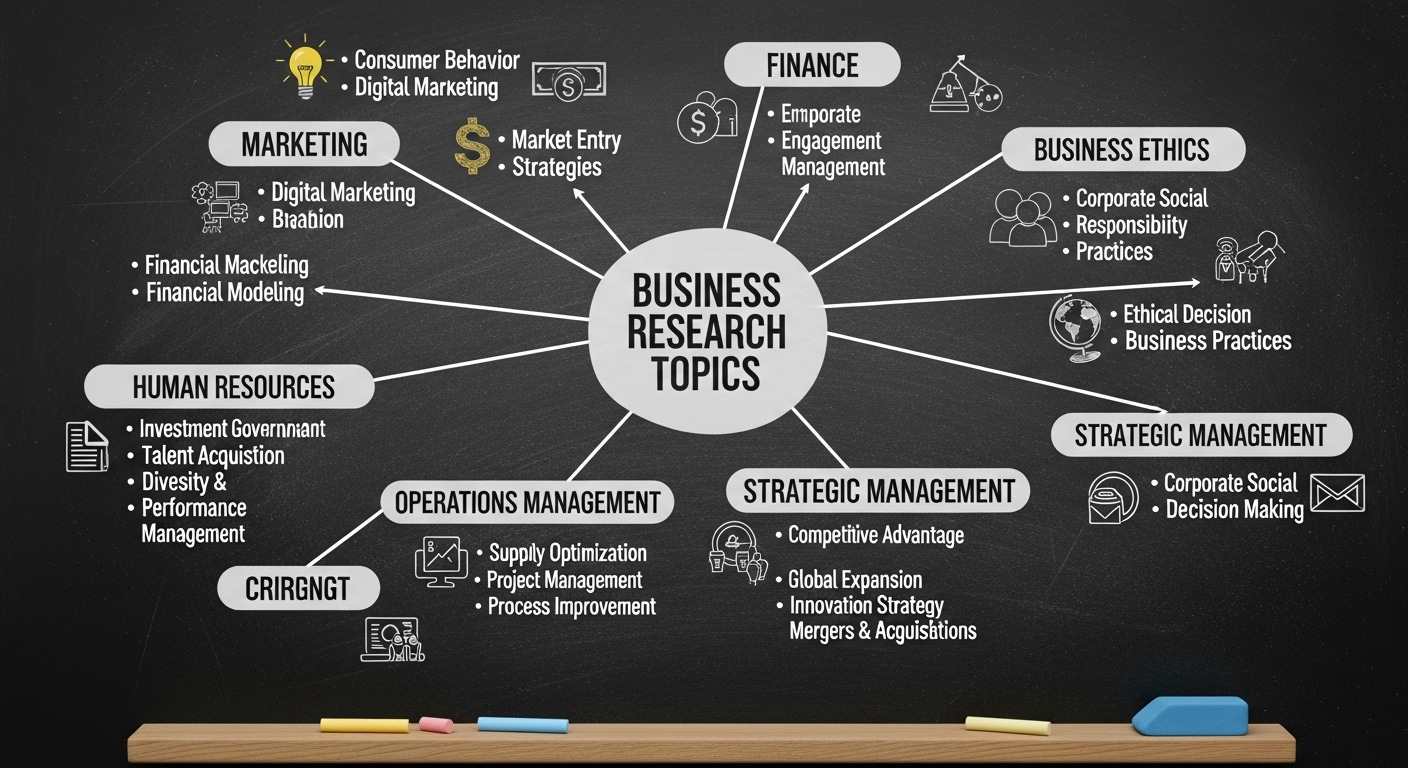
Business Research Topics by Specialization
Business education covers multiple disciplines. Below are categorized topic ideas suitable for college and MBA students.
Marketing Research Topics
- The impact of influencer marketing on consumer purchasing decisions
- Personalization strategies in digital marketing campaigns
- Consumer behavior trends in e-commerce platforms
- Brand loyalty in competitive retail markets
- Ethical issues in targeted advertising
- The role of data analytics in customer segmentation
- Social media marketing effectiveness across generations
- Sustainable branding strategies and consumer perception
Finance Research Topics
Financial risk management strategies in multinational corporations
- Cryptocurrency adoption in corporate finance
- Behavioral finance and investor decision-making
- The impact of inflation on corporate profitability
- Capital budgeting techniques in startup ventures
- Green finance and sustainable investment strategies
- Mergers and acquisitions performance analysis
- Financial forecasting using predictive analytics
Management Research Topics
- Leadership styles and employee productivity
- Remote work models and organizational performance
- Change management strategies in digital transformation
- Conflict resolution techniques in multinational teams
- Corporate governance and ethical decision-making
- Employee engagement and performance outcomes
- Diversity and inclusion in modern workplaces
- Strategic planning in competitive markets
Emerging and Trending Business Research Topics
Business environments are constantly evolving. Researching emerging trends demonstrates industry awareness and forward-thinking analysis.
Entrepreneurship and Innovation
- Startup ecosystem development in developing economies
- Innovation strategies in technology-driven companies
- Venture capital funding patterns in early-stage businesses
- Business model innovation in subscription-based services
Sustainability and Corporate Responsibility
- Corporate social responsibility and brand reputation
- Sustainable supply chain management practices
- Environmental regulations and business profitability
- ESG reporting standards and investor confidence
Business Analytics and Digital Transformation
- Artificial intelligence in decision-making processes
- Big data analytics in supply chain optimization
- Cybersecurity strategies in digital enterprises
- Automation and workforce transformation
Practical Tips for Selecting the Best Topic
- Align your topic with your academic specialization
- Ensure sufficient academic and industry sources are available
- Choose a subject that genuinely interests you
- Narrow broad themes into specific research questions
- Confirm topic approval with your instructor early
- Define measurable variables for analytical clarity
- Avoid repetitive or overly generic subjects
- Consider real-world case studies for stronger analysis
Challenges Students Face When Selecting Business Research Topics
Many students experience difficulty narrowing down broad business concepts into manageable research areas. Business as a field is expansive, covering marketing, finance, operations, strategy, and entrepreneurship. Without clear direction, topic selection becomes overwhelming.
Another challenge is selecting topics that are either too general or too complex. Overly broad subjects limit analytical depth, while highly technical themes may exceed academic scope or available data. Time constraints also influence decision-making, causing students to rush topic selection without evaluating research feasibility.
Additionally, MBA students often face higher expectations regarding originality and industry relevance. Balancing theoretical frameworks with practical case analysis requires strategic planning. Seeking structured inspiration and reviewing previous research formats can reduce uncertainty and improve topic quality.
How Strong Business Research Topics Improve Academic Performance
A well-chosen topic simplifies research planning, strengthens arguments, and improves grading outcomes.
Improved Research Structure
Clear topics enable organized outlines, logical arguments, and coherent analysis. This improves readability and academic credibility.
Stronger Analytical Depth
Focused research allows detailed evaluation rather than surface-level summaries. Analytical depth often distinguishes high grades from average submissions.
Enhanced Professional Relevance
Business research that addresses real-world problems builds practical knowledge. This strengthens both academic results and future career readiness.
Conclusion
Selecting the best business research topics for college and MBA students requires strategic thinking and careful evaluation. A strong topic should be focused, relevant, researchable, and aligned with academic goals. Categorizing ideas by specialization simplifies decision-making and improves clarity. Whether you are studying marketing, finance, management, or entrepreneurship, choosing a meaningful topic lays the foundation for impactful research. By narrowing your focus and aligning with industry trends, you increase both academic performance and professional insight.