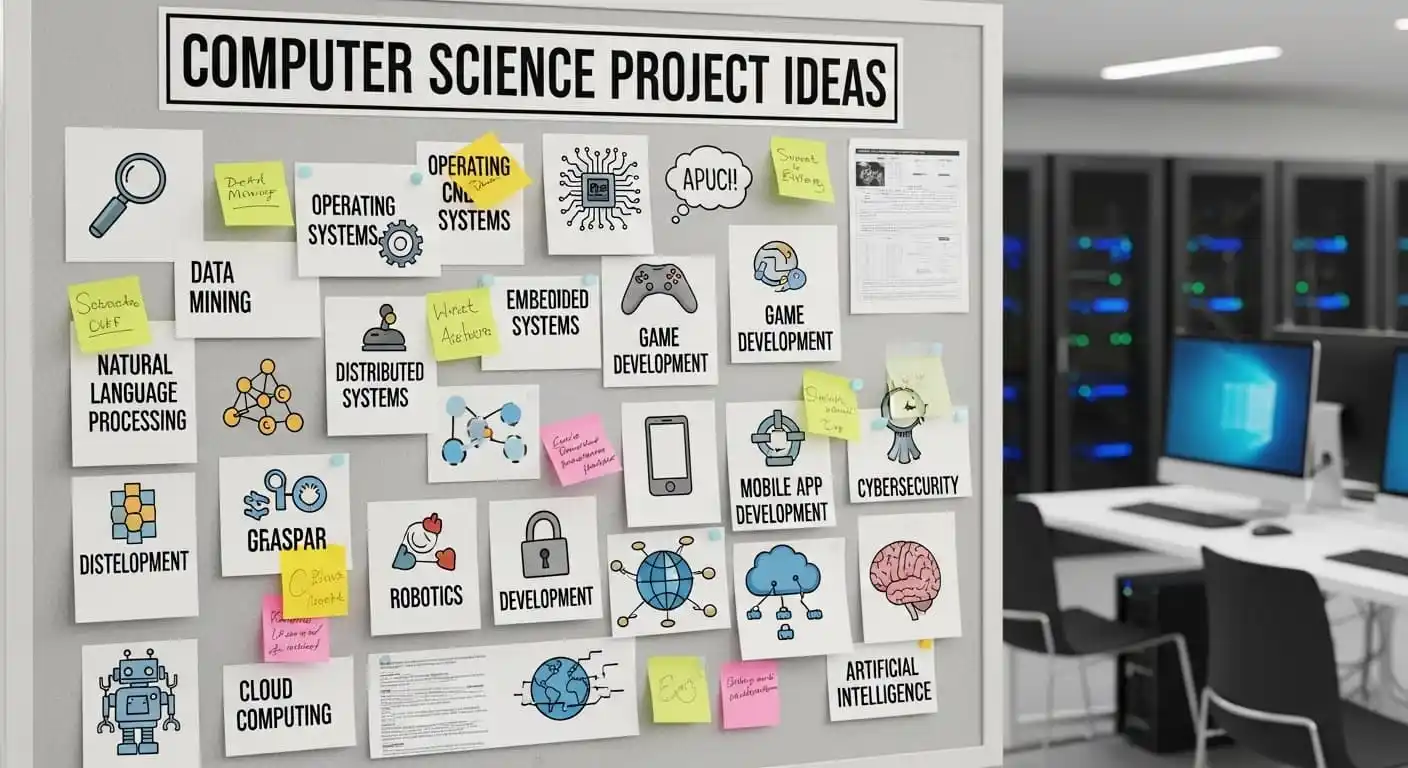
Top Computer Science Project Ideas for Students 2025

Top Computer Science Project Ideas for Students 2025

Choose a computer science project ideas by matching your current skill level (beginner → build, intermediate → extend, advanced → research/production) and your target career (industry role vs. grad school). Prioritise projects that produce a working demo, a clean code repo, and a short case-study (readme + video). These amplify hiring ROI and show problem-solving, not just finished code.

From Coursework to Career: What Makes a Project Stand Out?

A course assignment is finished when it meets the rubric constraints. A portfolio project is judged by signal: originality (solves a tangible problem), scope (complete prototype), reproducibility (clean repo + instructions), and impact (data, metrics, or user testing). Employers and grad programs look for evidence that you can (1) pick useful problems, (2) ship working systems, and (3) explain tradeoffs clearly.

Core Framework: How to pick, scope, and present project work

Below are 10 practical domains with project ideas at beginner → advanced levels, suggested stacks, what reviewers care about, and how each maps to measurable ROI (skills or roles it helps you land).

1) Machine Learning (ML)

Project ideas

  • Beginner: Image classifier for a public dataset (CIFAR-10 / Fashion-MNIST) with clear preprocessing and evaluation.
  • Intermediate: Transfer-learning pipeline + explainability (Grad-CAM) for domain-specific images (medical, agriculture).
  • Advanced: Small-scale production ML pipeline: model training, model-serving (FastAPI), A/B testing, monitoring.

Tech stack: Python, PyTorch/TensorFlow, scikit-learn, FastAPI/Flask, Docker, MLFlow or Weights & Biases.

What to show: Data provenance, baseline vs final metrics, confusion matrix, ablation study, reproducible training script.

Career ROI: Strong pathway into ML engineering, research assistantships, or data-science roles aligns with rapid investment and adoption in AI across industries.

2) Data Science & Data Analysis

Project ideas

  • Beginner: Exploratory data analysis (EDA) notebook + storytelling dashboard (Streamlit) on a public dataset.
  • Intermediate: End-to-end pipeline: data ingestion, cleaning, feature engineering, model, and business KPI mapping.
  • Advanced: Time-series forecasting with model ensembling and deployment for an operational metric.

Tech stack: Python, pandas, Jupyter, scikit-learn, Streamlit/Plotly Dash, SQL.

What to show: Reproducible notebooks, clear business question → metric mapping, and a dashboard or short narrated video.

Career ROI: Data analyst → data scientist transition; employers value domain-driven metrics and reproducible insights.

3) Web Development (Full-stack)

Project ideas

  • Beginner: CRUD app with user auth (e.g., task manager).
  • Intermediate: Progressive Web App (PWA) with offline functionality and responsive UI.
  • Advanced: Multi-tenant SaaS prototype (billing simulation, role-based permissions) with CI/CD.

Tech stack: React / Vue, Node.js / Django / Flask, PostgreSQL, Docker, GitHub Actions.

What to show: UX flow, accessibility basics, automated tests, deployment link (even to a free tier).

Career ROI: Directly maps to internships and junior/full-stack engineering roles; strong evidence if you show testing, performance tuning, and real-world deployment.

4) Mobile App Development

Project ideas

  • Beginner: Simple cross-platform app (Flutter / React Native) with local storage.
  • Intermediate: App integrated with backend APIs + push notifications and analytics.
  • Advanced: Edge-enabled app using on-device ML (image/text) with privacy-preserving features.

Tech stack: Flutter or React Native, Firebase or custom backend, Android Studio / Xcode for native debugging.

What to show: Play Store / TestFlight builds or APK + user-testing notes; instrumentation for analytics.

Career ROI: Demonstrates product thinking and end-to-end engineering, valuable for roles in mobile engineering and startups.

5) Computer Vision (CV)

Project ideas

  • Beginner: Object detection using pre-trained models (YOLO, Detectron).
  • Intermediate: Custom dataset collection, annotation, training a detector, and deployment demo (webcam-based).
  • Advanced: Real-time multi-object tracking + low-latency optimisations on edge hardware (Jetson / Raspberry Pi).

Tech stack: OpenCV, PyTorch, TensorRT, labelImg, ONNX.

What to show: Dataset curation details, latency/throughput metrics, and real-world robustness tests.

Career ROI: Prepares you for roles in robotics, autonomous systems, and industrial vision applications.

6) Natural Language Processing (NLP)

Project ideas

  • Beginner: Text classification or named-entity extraction on public corpora.
  • Intermediate: Build a retrieval-augmented generation (RAG) demo or an intelligent Q&A bot with source citing.
  • Advanced: Fine-tune a compact LLM for a niche domain and deploy as a service with prompt-safety checks.

Tech stack: Hugging Face Transformers, LangChain or RAG tooling, FastAPI, Docker.

What to show: Evaluation by humans where necessary, clear safety/ethics notes, and cost/latency tradeoffs.

Career ROI: Strong fit for research labs, NLP engineering, and product teams building conversational or knowledge systems.

7) Cybersecurity & Ethical Hacking

Project ideas

  • Beginner: Vulnerability scanning and threat model write-up for a small web app.
  • Intermediate: Build a capture-the-flag (CTF) challenge + write an exploitation/patch analysis.
  • Advanced: Implement a small intrusion-detection prototype (ELK stack ingestion + anomaly detection) and demonstrate red/blue team exercises.

Tech stack: Kali tools, Metasploit (educational use), Wireshark, ELK stack, Python for automation.

What to show: Responsible disclosure, step-by-step methodology, and defensive remediation suggestions.

Career ROI: High demand for security-aware engineers and entry-level security analysts; cybersecurity hiring remains a priority as digital footprints grow.

8) Internet of Things (IoT) & Embedded Systems

Project ideas

  • Beginner: Sensor data logger with visualization (temperature, motion).
  • Intermediate: Secure IoT prototype that streams encrypted telemetry to the cloud + OTA update simulation.
  • Advanced: Edge analytics pipeline: on-device preprocessing, model inference, and adaptive sampling to save bandwidth.

Tech stack: Arduino / Raspberry Pi / ESP32, MQTT, lightweight inference (TensorFlow Lite), cloud IoT services.

What to show: Power and bandwidth budgets, physical demo or video, and security considerations.

Career ROI: Relevant for hardware startups, smart-environment R&D, and roles combining software + hardware benefit from growth in edge/IoT deployments.

9) Algorithms & Data Structures

Project ideas

  • Beginner: Implement classic algorithms (sorting, graph traversals) with a visualiser UI.
  • Intermediate: Solve and optimise a specific problem family (e.g., route planning with constraints) and compare algorithms empirically.
  • Advanced: Research-style project: develop or adapt an algorithm for large-scale datasets and analyze complexity and empirical performance.

Tech stack: C++ / Java / Python, visualization libraries, benchmarking harness.

What to show: Theoretical bounds + empirical scalability testing, readable proofs or intuition.

Career ROI: Strong signal for roles that require algorithmic thinking (SWE, competitive programming teams, grad school).

10) Blockchain & Smart Contracts

Project ideas

  • Beginner: Simple smart contract (ERC-20-like) deployed on a testnet with a web UI.
  • Intermediate: Build a small dApp that demonstrates governance or a tokenized workflow with security audits (basic).
  • Advanced: Cross-chain prototype or a formal-verification-backed contract plus a threat model and bug-bounty-style tests.

Tech stack: Solidity / Hardhat / Truffle, Ethers.js, Remix, testnets, formal tools like MythX.

What to show: Security audits, gas-cost analysis, and clear UX for trust assumptions.

Career ROI: While speculative markets change, enterprise smart-contract demand and tooling for tokenized business logic continue to expand; clear, audited demos are most persuasive.

ROI Considerations — tuition, opportunity cost, and hiring signal

Tangible ROI variables to weigh

  • Time to completion (opportunity cost): A 2–4 week focused mini-project can prove competency quickly; a production-grade project shows depth but costs more time.
  • Monetary cost (tools/compute): Factor cloud/GPU costs if you plan large ML experiments, include them in the project README so reviewers understand scope.
  • Signal vs. Noise: Recruiters spend <1–2 minutes on a portfolio item; lead with a 2-minute demo video, key metrics, and top-level results.
  • Skill transferability: Choose projects that teach stack and soft skills employers want (API design, testing, monitoring, security).
  • Evidence of impact: Include user metrics, performance gains, or a short case study that quantifies improvement (e.g., latency reduced by 40%, accuracy improved by 6 points).

How market trends should influence your choice

  • Pick ML/NLP if you aim for AI/ML roles; these fields have seen large investment and adoption growth in 2024–2025.
  • Prioritise cybersecurity or secure-by-design projects if you want to enter the security field, as global cybersecurity needs and talent gaps remain acute.
  • Consider smart-contract work if you’re interested in fintech/web3 infrastructure. The market shows ongoing growth, but expect variable hiring patterns.

Conclusion

Choosing the right computer science project is not just about meeting course requirements; it is about signalling your capabilities to future employers, graduate admissions committees, and research supervisors. When you select a project that aligns with your skill level and long-term career goal, you create a portfolio asset that demonstrates technical depth, problem-solving, and real-world impact. Whether you pursue Machine Learning, Web Development, Cybersecurity, or Blockchain, aim for projects that show clarity, originality, and measurable results. A strong project today can meaningfully influence your academic direction and professional trajectory tomorrow.

FAQs

How do I choose the best computer science project for my skill level?

Select a project based on your current technical confidence. Beginners should focus on foundational builds, intermediate students should extend existing systems, and advanced learners should tackle research-driven or production-grade problems.

How many projects should I include in my portfolio?

Quality matters more than quantity. Two to four well-documented, finished projects with demos are far more valuable than several incomplete assignments.

Which CS domains offer the best career opportunities in 2025?

Machine Learning, Cybersecurity, Data Science, and AI-driven applications continue to have strong hiring demand. However, any domain where you can demonstrate complete system thinking can be valuable.

Do I need to deploy my project online for it to be considered strong?

Deployment strengthens credibility. Even a basic hosted demo or a short video walkthrough can significantly improve how your work is evaluated by recruiters and professors.

Can academic projects help me get internships or entry-level jobs?

Yes. Employers increasingly look at project portfolios to assess practical skills, especially when students have limited professional experience. A strong project can act as a direct portfolio sample during interviews.