Critical Thinking in Science: How Curiosity Fuels Discovery

Critical Thinking in Science

Have you ever paused mid-experiment and wondered why a simple question can spark an entire scientific journey? In science, curiosity and critical thinking are like two sides of the same coin.

One pushes us to ask sharp, probing questions, while the other urges us to explore the unknown with enthusiasm. In this post, we’ll dive into why developing both skills is essential for anyone eager to unlock the wonders of discovery.

What Is Critical Thinking in Science?

Defining Critical Thinking

  • Goes beyond memorizing facts.
  • Involves examining evidence, identifying assumptions, and evaluating conclusions.
  • Helps spot biases, challenge weak methods, and separate solid research from questionable findings.

The Role of Critical Thinking in the Scientific Method

  • Guides hypothesis formation: “What evidence supports this idea?”
  • Shapes experiment design: “How can I control variables for reliable results?”
  • Drives data interpretation: “Are there errors or alternative explanations?”
  • Ensures findings remain accurate and trustworthy.

Benefits of Cultivating Critical Thinking Skills

  • Effective problem-solving: Step-by-step analysis reduces overlooked details.
  • Clear communication: Rigorous methods make results easier to trust.
  • Flawed-methodology detection: Spot small sample sizes or missing controls.
  • Real-world example: Cold fusion claims in 1989 were debunked through rigorous critique, illustrating the power of critical thinking.

What Is Curiosity in Science?

Defining Curiosity

  • The irresistible drive to ask “What if?” and explore deeper.
  • Goes beyond surface interest to seek underlying mechanisms.
  • Fuels desire to know how and why things happen.

How Curiosity Drives Discovery

  • Isaac Newton’s apple: Curiosity about gravity led to foundational physics.
  • Alexander Fleming’s mold: Instead of discarding a contaminated petri dish, he investigated and discovered penicillin.
  • History shows curiosity can lead to paradigm shifts.

Benefits of Fostering Curiosity

  • Increased engagement: Learning becomes an adventure rather than a chore.
  • Innovative thinking: Connecting ideas across fields sparks breakthroughs.
  • Interdisciplinary connections: For example, biomimicry gains from observing nature (gecko’s grip → new adhesives).

The Symbiotic Relationship: Critical Thinking Meets Curiosity

Why You Need Both

  • Curiosity in Science is the spark; Critical Thinking in Science fans the flame.
  • Curiosity asks “What happens if…?”How do I know this is valid?” is a question that critical thinking poses.
  • Alone, curiosity can lead to untested ideas; alone, skepticism can block innovation.

Balancing Creative Wonder with Analytical Rigor

  • Blind Curiosity: Too many questions without testing any.
  • Overly Skeptical Thinking: Dismissing new ideas before exploring them.
  • Strategy: Pair brainstorming sessions (free exploration) with critique meetings (structured evaluation).

Case Study: Marie Curie’s Breakthrough

  • Driven by curiosity, she isolated radium from pitchblende ore.
  • Faced skepticism but used meticulous experiments to validate findings.
  • Resulted in advances in physics, chemistry, medical imaging, and cancer treatment.

Practical Strategies to Develop Critical Thinking in Science

Questioning Assumptions

  • “Five Whys” Method: Ask “Why?” five times to find root causes.
  • Structured skepticism: Challenge observations: “Could another factor explain this?”
  • Exercise: Trace evidence behind “Water boils at 212°F at sea level.” How does altitude affect it?

Evaluating Evidence and Sources

  • Prefer peer-reviewed journals over anecdotal claims.
  • Check sample sizes and controls for statistical power.
  • Activity: Compare a top-tier journal paper with a lesser-known venue. List strengths and weaknesses.

Logic and Reasoning Exercises

  • Deductive reasoning: Apply general principles to specific scenarios (e.g., metal expansion when heated).
  • Inductive reasoning: Observe patterns and derive general rules (e.g., acid-base reactions releasing CO₂).
  • Resources: Logic puzzles on Brilliant or in puzzle books.

Reflective Practice

  • Journaling: Note methods, biases, and thought processes in a science notebook.
  • Group discussions: Join a journal club for peer review and fresh perspectives.

Practical Strategies to Nurture Curiosity in Science

Cultivating a “Question of the Day” Habit

  • Ask a simple question each morning (e.g., “Why do tides follow the moon?”).
  • Keep a Curiosity Notebook to track these sparks and spot patterns.

Exploring Interdisciplinary Connections

  • Read outside your field: A history or philosophy book can spark fresh ideas.
  • Attend workshops: Seminars from different departments often lead to surprising insights.

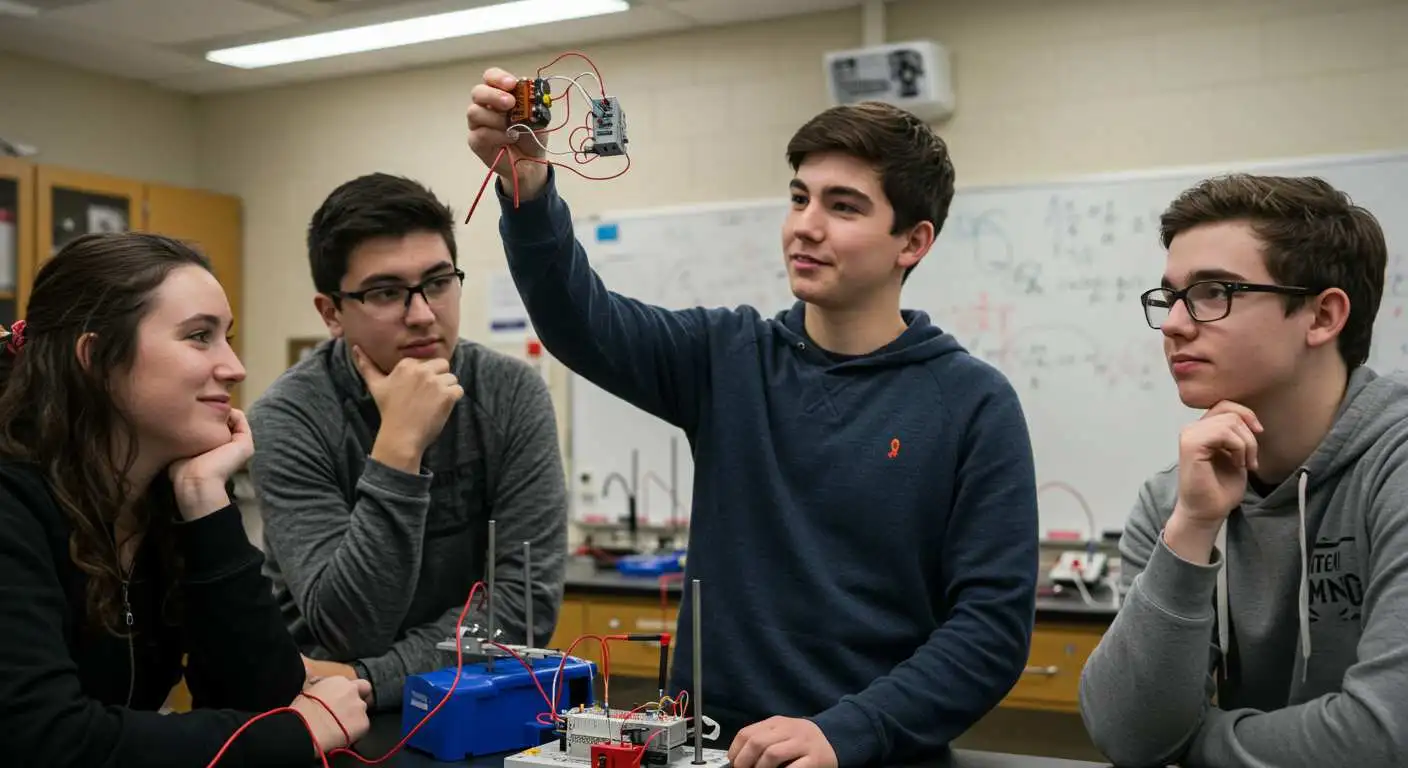
Hands-On Experimentation

  • Kitchen-science demos: Test pH with red cabbage juice or observe osmosis with an egg in vinegar.
  • Local museums and maker spaces: Interactive exhibits and workshops reignite wonder.

Embracing “Failure” as Part of the Journey

  • Reframe failures: Ask “What did I learn?” rather than viewing it as an end.
  • Famous example: Thomas Edison’s thousands of filament tests eventually led to a practical lightbulb, turning “failures” into stepping stones.

Real-World Examples: Success Stories

From Lab Bench to Nobel Prize (CRISPR)

  • Curiosity about bacterial defense mechanisms led to a gene-editing breakthrough.
  • Rigorous testing (critical thinking) transformed that curiosity into a Nobel-winning tool.

Citizen Science and DIY Researchers

  • Galaxy Zoo: Enthusiasts classify galaxies, applying curiosity to explore the cosmos and critical thinking for accuracy.
  • Participants help real research by following structured protocols.

Innovators Outside Academia (James Dyson)

  • Tested over 5,000 vacuum prototypes driven by “How can I make suction more efficient?”
  • Paired endless curiosity with rigorous data analysis to produce a game-changing product.

Overcoming Common Obstacles

Combating Confirmation Bias

  • Look for evidence that contradicts: Seek out information that challenges your theory.
  • Peer review: Colleagues can catch biases you might miss.

Battling Curiosity Fatigue

  • Micro-breaks: Short walks or switching tasks can reignite curiosity.
  • Rotate projects: Switch between lines of inquiry to prevent burnout and let ideas incubate.

Handling Criticism and Skepticism

  • Stay open-minded: Use healthy skepticism to refine ideas without extinguishing curiosity.
  • Learn from feedback: Ask peers, “What part of my methodology concerns you?” and improve.

Conclusion

Critical thinking and curiosity together turn simple questions into big discoveries. Try one strategy—like a daily “Question of the Day” or the “Five Whys”—for a week, and see how often your mind seeks new answers. 

And remember, when asking yourself, Why Is Time Management Important for Students, the answer lies in making space for both exploration and reflection. 

Science thrives on both “What if?” and “How do I know?” So go ahead, ask your next question and be your own detective. 

Good luck!