I see your stress If you’ve ever asked yourself, is English hard to learn? and you’re not alone If you’re an undergraduate, master’s or Ph.D. student juggling coursework, readings, and deadlines while learning English, you already understand the pressure grades, publications, presentations and the need to sound confident in academic settings.
This guide promises a research-informed, practical route to measurable improvement not fluffy motivation so you can level up your academic English and protect your GPA, presentation scores, and publication chances.
English has specific difficulties for non-native speakers, but with targeted strategies (grammar diagnostics, pronunciation drills, corpus-informed reading, and academic writing methods), you can accelerate progress and produce work that meets U.S. higher-education standards.
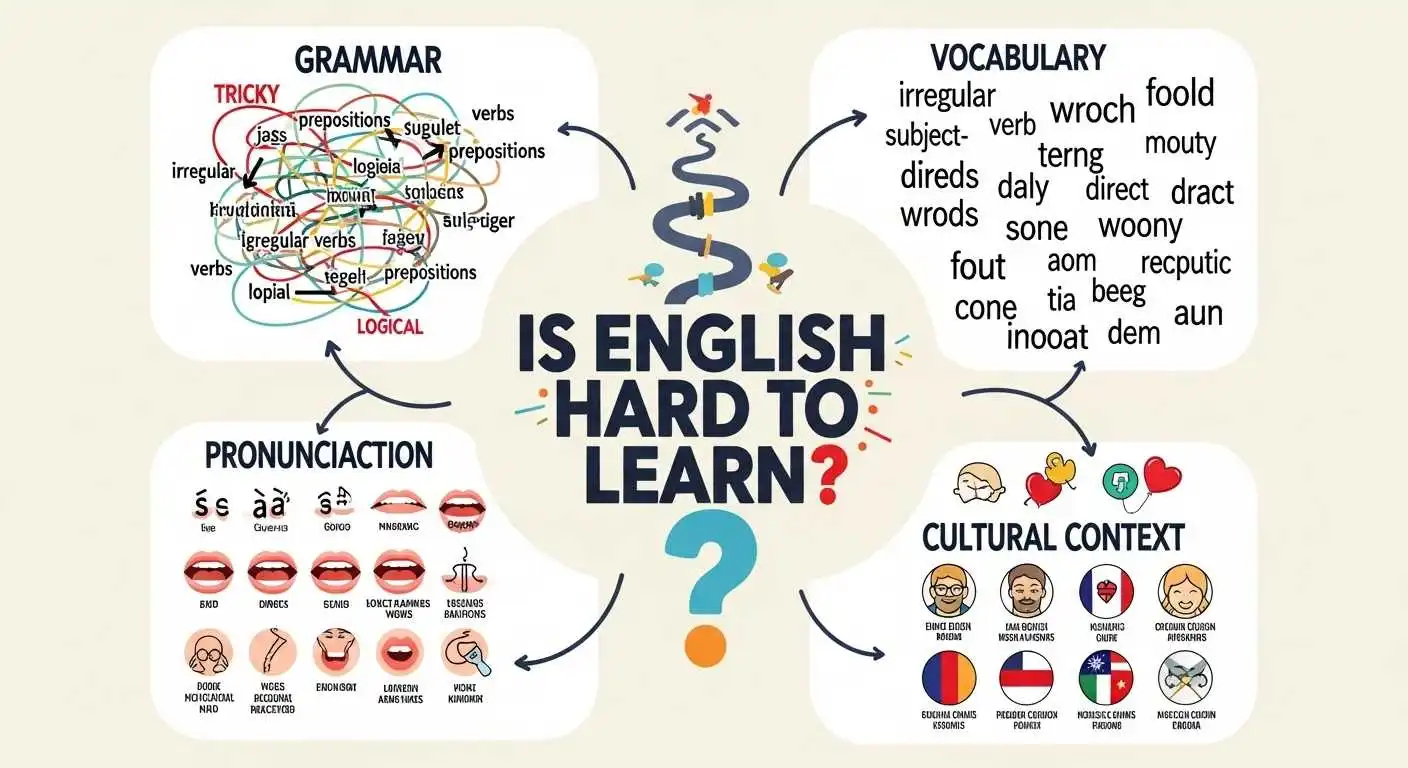
Why is English Hard for Non-Native Speakers?
English can feel inconsistent and unpredictable for several evidence-backed reasons:
- Irregular orthography (spelling ↔ pronunciation): English spelling and pronunciation often don’t map one-to-one (e.g., tough, though, through).
- Large vocabulary with many synonyms and register differences: Academic vs. conversational vocabulary differs sharply (compare get vs obtain vs procure).
- Complex grammar exceptions: Articles, phrasal verbs, and modal usages cause frequent learner errors.
- Pronunciation variation: Regional accents and reduction (weak forms) make listening comprehension challenging.
- Cultural and pragmatic conventions: Academic writing conventions (e.g., hedging, citation practices) are culturally bound and unfamiliar to many learners.
The Cultural Context of Learning English
Language isn’t just grammar and vocabulary — it’s culture in motion. English carries deep cultural values, idioms, and communication patterns that reflect the societies where it’s spoken. For non-native speakers, understanding these cultural nuances is essential for mastering both conversational and academic English.
- Idioms and cultural metaphors: Expressions like “break the ice” or “hit the books” make little literal sense unless you grasp their cultural meaning.
- Academic communication norms: U.S. universities favor polite, indirect phrasing and evidence-based argumentation. Phrases like “The results suggest…” are preferred over “This proves…”.
- Pragmatic differences: Turn-taking in seminars, addressing professors, and using respectful tones vary by culture, influencing how students express themselves.
- Cultural immersion through media: Watching lectures, documentaries, or English podcasts exposes learners to authentic tone, humor, and academic style, making comprehension and participation easier.
Recognizing English as both a linguistic and cultural system allows students to engage more confidently in academic and social settings, bridging communication gaps and enhancing fluency.
Is English the Hardest Language to Master?
Short answer: No — but it’s uniquely tricky.
Difficulty depends on your native language. Languages with similar structures (e.g., Germanic languages) are often easier to acquire than typologically distant ones (e.g., Mandarin, Arabic).
English’s difficulty lies less in a single “hard” grammar point and more in the breadth of irregularities and register differences you must master to perform academically.
Challenges of Learning English Grammar
Many students report the same recurring grammar pain points:
- Article use (a / an / the / zero article) in academic writing.
- Subject-verb agreement in long complex sentences.
- Tense sequences and aspect (present perfect vs. simple past).
- Phrasal verbs and preposition selection.
- Nominalization and academic sentence structure (dense noun phrases).
How to Diagnose Grammar Weaknesses
- Take a timed diagnostic writing task (300–500 words on a familiar academic topic).
- Use error-coding (articles / verb forms / word order / prepositions / punctuation).
- Compute error frequency (errors per 100 words); target the top 2–3 error types for remediation each week.
Common Mistakes When Learning English & How to Fix Them
Common mistakes are predictable — which is good news, because it means targeted fixes work.
- Mistake: Overusing the simple present in literature reviews.
Fix: Learn verbs of reporting and use present perfect when summarizing ongoing research (practice with annotated literature reviews). - Mistake: Incorrect article use in abstracts.
Fix: Drill definite vs. indefinite with real academic examples (e.g., “the study shows” vs. “a study shows”). - Mistake: Literal translations causing unnatural collocation (e.g., make a research).
Fix: Use corpus tools or collocation dictionaries to learn verb-noun pairings common in academic English.
How to Improve English Pronunciation — Practical Drills for Busy Students
A polished pronunciation improves intelligibility in seminars and during defenses.
- Shadowing: Listen to a 1–2 minute academic lecture excerpt and speak along exactly with the speaker, matching rhythm and stress.
- Minimal pairs: Target vowel/consonant contrasts that your native language lacks (e.g., ship / sheep).
- Record + compare: Record a 60-second rehearsal of your presentation, compare waveform and timing against a native speaker, and note 2–3 measurable improvements each iteration.
- Phonetic awareness: Learn key IPA symbols for problem sounds and practice them in context (not isolation).
- Connected speech drills: Practice linking, reductions, and intonation patterns used in academic Q&A.
Tips to Learn English Faster — Evidence-Based Study Plan
Below is a compact, high-impact weekly plan tailored for students.
5 Steps to Faster Academic English
- Baseline & goals (Week 0): Diagnostic writing + speaking sample; set SMART academic targets (e.g., reduce article errors from 4/100 words to 1/100 in 8 weeks).
- Deliberate practice (Weeks 1–8): 30–45 minutes/day focused on high-impact tasks: grammar micro-lessons, pronunciation drills, and reading academic texts.
- Corpus-informed reading (Ongoing): Read 1 research article/week in your field; annotate collocations, hedging phrases, citation language.
- Active production (Weekly): Write a 250–500 word mini literature review or a conference abstract; present it in a study group or record and self-evaluate.
- Measurement & adaptation (Biweekly): Re-run the diagnostic, track error types, and adjust focus.
The Easiest Way to Learn English fluently
There’s no instant route to fluency. But the easiest path—meaning most efficient and high-yield for students—combines input + guided output + feedback:
- Input: Targeted reading of academic texts in your discipline (literature review chapters, journal articles).
- Guided output: Structured writing tasks with templates (abstracts, methodology summaries).
- Feedback: Regular corrective feedback from a subject specialist or language tutor focused on academic conventions (APA 7th edition formatting, citation style, and disciplinary register).
Academic English for Research: Linking Language to Methodology
Whether writing a literature review or describing your dissertation methodology, precision of language matters.
- Literature review: Use reporting verbs accurately (e.g., argues, suggests, demonstrates) and practice summarizing studies in single-sentence syntheses.
- Dissertation methodology: Write stepwise with clear passive/active voice decisions (e.g., “We conducted a quantitative analysis” vs “A quantitative analysis was conducted”). Use discipline-appropriate lexicon.
- Citations & format: Follow APA 7th edition for social sciences; include in-text citations, a formatted reference list, and a transparent methodology description to satisfy examiners.
Actionable Strategies — Study tools and Exercises That Produce Grades
High-Impact Study Tools
- Spaced-repetition flashcards (Anki) for academic vocabulary (Academic Word List + discipline-specific terms).
- Grammar error tracker: a simple spreadsheet to log error type, sample sentence, correction, and frequency.
- Pronunciation log: weekly recording files with timestamps and improvement notes.
- Annotated literature review template (300 words) with signal phrases, synthesis sentence, and citation examples.
- Presentation checklist: slide language, rehearsed Q&A phrases, time-stamped voice recordings.
Checklist for Original and High-Scoring Academic Writing
- Verify every direct quote has a page number and citation (APA 7th edition).
- Paraphrase source ideas and add your analysis — don’t substitute synonyms only.
- Run a similarity check (institutional tool) and resolve matches above your school’s threshold.
- Keep a research log showing source provenance (useful in viva/defense).
- Use citation managers (Zotero, Mendeley) and export in APA 7th edition.
Assessment & Measurement — How to Know You’re Improving
Use objective benchmarks meaningful to higher-ed:
- Writing: errors per 100 words; clarity score from peer reviewer rubric; instructor feedback grade.
- Speaking: intelligibility rating by 2 peers (1–5), time-controlled fluency (words per minute without hesitation).
- Standard tests: CEFR level estimations, IELTS/TOEFL section targets if required for scholarships or program progression.
- Research output: cleanly formatted abstract compliant with APA; a short literature review that reads like a publishable piece.
Practical Examples — Fix a Recurring Error
Problem: Student repeatedly misuses articles in methodology descriptions: “We used a survey to collect data” → “We used the survey to collect data.”
Steps to fix:
- Identify why: is the student referencing a specific instrument? If yes, use the.
- Practice substitution: create 10 context sentences, swap articles, and explain the difference.
- Apply to writing: edit your methods section with tracked changes and justify each article choice in comments.
Closing
Learning academic English is a marathon with sprints — the marathon is disciplinary fluency (years), but the sprints (weekly targeted practice) produce visible grade improvements in weeks. Prioritize diagnostic measurement, focused remediation on high-frequency errors, and disciplined output with feedback.
If you implement the strategies here, you’ll see clearer writing, more confident presentations, and fewer revision cycles during thesis submission or publication.
And if you ever feel stressed about your English assignments or language challenges, Scholarly Help is here to take that burden off your shoulders — so you can focus on learning while we handle the rest with expert care.