Mechanisms of Reproductive Isolation
Reproductive isolation is the central pillar of the biological species concept. It prevents gene flow between populations, allowing them to evolve independently.
Prezygotic Barriers
Prezygotic barriers prevent mating or fertilization from occurring. These include differences in mating behavior, habitat preferences, breeding seasons, and mechanical incompatibility. For example, closely related species may live in the same region but reproduce at different times of the year.
Postzygotic Barriers
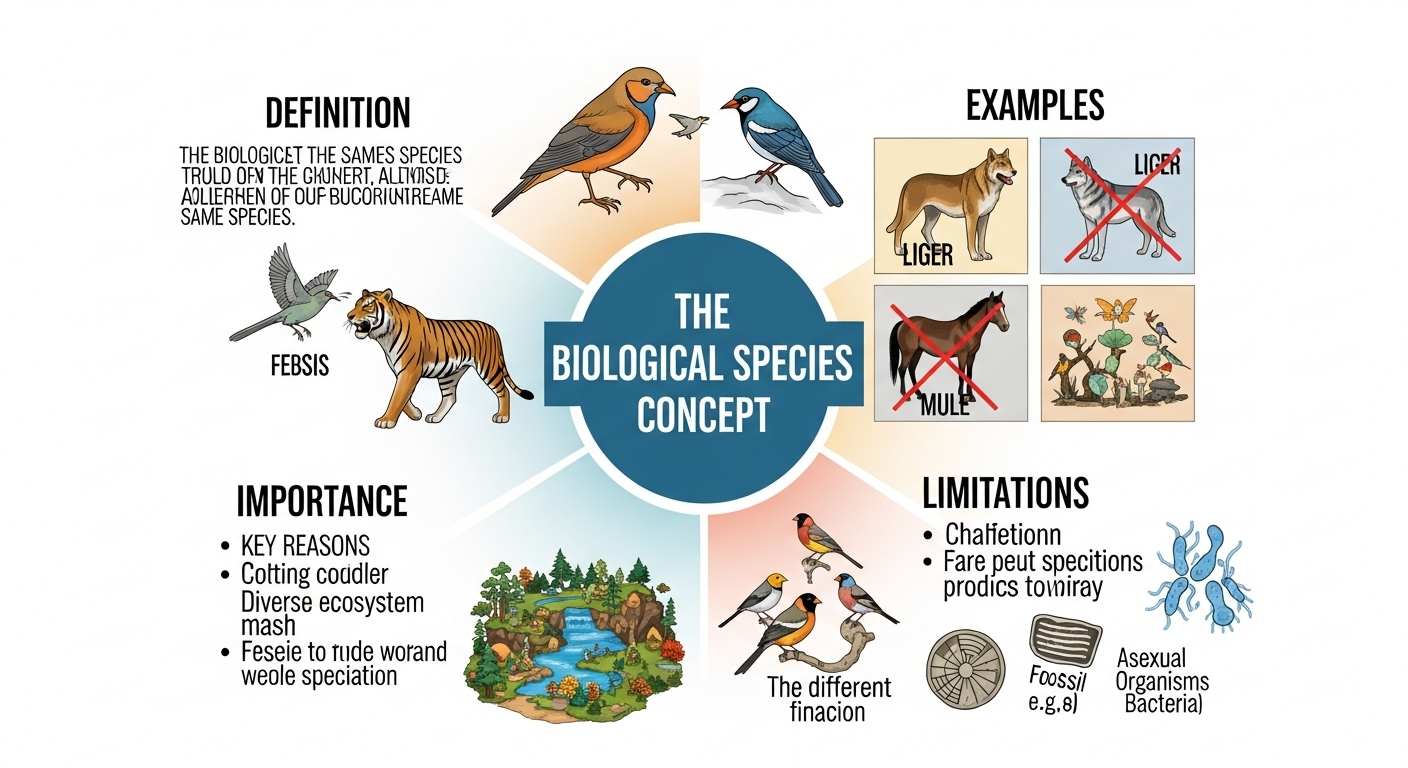
Postzygotic barriers occur after fertilization. Hybrid offspring may be weak, sterile, or unable to survive. A classic example involves horses and donkeys producing mules that are typically sterile. Such outcomes reinforce species boundaries.
Importance in Evolutionary Biology
The biological species concept plays a foundational role in understanding evolution and biodiversity.
Role in Natural Selection
By defining species as genetically isolated groups, the concept clarifies how Natural selection acts independently within each lineage. Genetic changes accumulate within populations without mixing with others.
Contribution to Taxonomy
In biological classification systems influenced by Taxonomy, reproductive isolation provides a biological basis for distinguishing species rather than relying solely on morphology.
Genetic Perspective
Modern advances in Genetics support the concept by demonstrating how gene flow maintains species integrity while isolation drives divergence.
Strengths of the Biological Species Concept
- Provides a clear and testable definition of species
- Focuses on evolutionary processes rather than appearance
- Explains mechanisms behind speciation
- Aligns with modern genetic research
- Widely accepted in evolutionary biology
- Useful in conservation planning
- Reduces confusion caused by morphological variation
Limitations of the Biological Species Concept
While influential, the concept has limitations.
Asexual Organisms
It cannot be applied effectively to organisms that reproduce asexually because interbreeding is not involved.
Fossil Species
Extinct species cannot be evaluated for reproductive compatibility, limiting its use in paleontology.
Hybridization Cases
In some cases, closely related species can produce fertile hybrids, blurring species boundaries and challenging strict interpretations.
Pain Points and Common Confusions
Many students struggle to understand the-biological-species-concept because it appears simple but contains complex implications.
- Confusion between physical similarity and reproductive compatibility
- Difficulty distinguishing prezygotic and postzygotic barriers
- Uncertainty about how hybrids affect classification
- Misunderstanding how the concept applies to microorganisms
- Overlooking exceptions in nature
These challenges often arise in academic settings and competitive assessments. Students preparing for biology-based evaluations can strengthen their conceptual clarity by reviewing structured exam resources such as those available on the Scholarly Help exams page.Clear understanding of foundational concepts like species definitions improves performance in higher-level biology courses and degree programs, including those outlined in guides such as what can you do with a biological science degree.
.
Comparison with Other Species Concepts
The biological species concept is one of several frameworks used in evolutionary biology.
Morphological Concept
This approach defines species based on physical traits. While useful for fossils, it can misclassify organisms with similar appearances but different reproductive systems.
Phylogenetic Concept
This method identifies species based on evolutionary lineage and shared ancestry using genetic data. It is particularly helpful when reproductive data is unavailable.
Ecological Concept
This concept defines species based on ecological roles and environmental niches. It highlights how organisms adapt to specific habitats.
Each concept serves specific research needs, but the biological species concept remains central for studying sexually reproducing organisms.
Practical Applications
Understanding the biological species concept has real-world importance.
Conservation Biology
Protecting species requires clear definitions. Reproductive isolation helps determine which populations need separate conservation strategies.
Biodiversity Assessment
Researchers studying ecosystems rely on species definitions to measure biodiversity accurately.
Academic Pathways
Students pursuing careers in biological sciences often encounter this concept early in their academic journey. For those exploring academic and career options, structured guidance such as what can you do with a biological science degree provides insight into pathways where evolutionary principles play a critical role.
Conclusion
The biological species concept remains a foundational pillar of modern evolutionary biology. By defining species through reproductive isolation and gene flow, it offers a process-based understanding of biodiversity. Although it has limitations, particularly regarding asexual organisms and fossils, its explanatory power in sexually reproducing populations is unmatched. It connects genetics, evolution, and taxonomy into a coherent framework. For students and researchers alike, mastering this concept strengthens comprehension of speciation, natural selection, and species classification. Its relevance continues to shape biological research and academic study today.