

How Long Is the AP Economics Exam? A Complete Breakdown of AP Macro and Micro Exam Length
If you’ve never taken a full AP Economics exam, it can be hard to know what to expect. How much time is allotted for the multiple-choice and free-response sections? Do AP Macro and AP Micro follow the same exam timing?
Racing Against the AP Economics Clock?
Stop guessing how much time you have left on each section. Pay someone to take my economics exam and finally relax.
If you don’t know the exact AP Economics exam duration before test day, you’re essentially pacing yourself without a plan, and effective time management can make a significant difference in your performance.
This guide explains the AP Economics exam length section by section, so you know exactly what to expect. It also highlights the timing differences and similarities between AP Macro and AP Micro.
If a demanding semester leaves you with little time to prepare, investing in a trusted expert for your homework can keep your coursework on track while giving you more time to practice full-length timed exams.
What Is the AP Economics Exam Duration?
Most of the pressure students feel comes from not knowing how the exam is timed rather than from the economics itself. However, once you understand how the sections are organized, the AP Economics exam becomes much easier to manage.
The AP Economics program is really made up of two separate College Board exams, not one:
- AP Macroeconomics: Covers the overall economy using the standard AP exam format and timing.
- AP Microeconomics: Focuses on individual markets while following the exact same exam structure.
Think of it this way: Macro changes the economic topics, and Micro changes the market focus, but the timing and exam format stay the same, making the test much easier to prepare for once you know the structure.
Understanding the AP Economics Exam Format: 6 Core Components
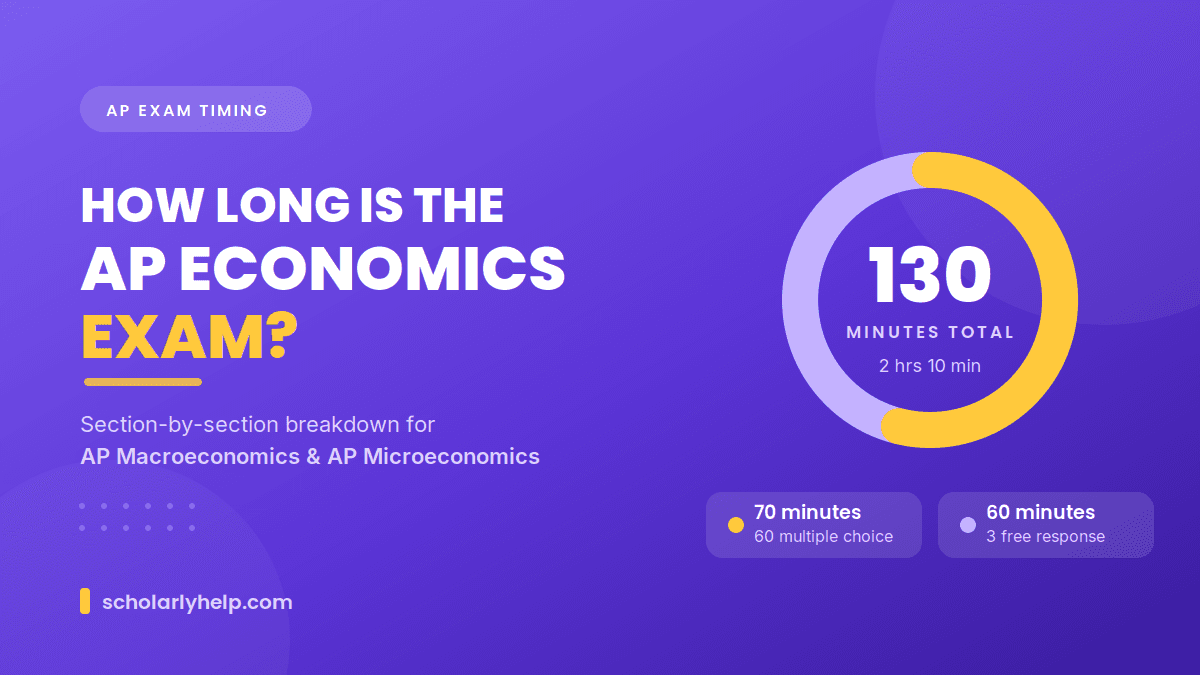
130 minutes (2 hours 10 minutes) for both AP Macro and AP Micro.
60 multiple-choice questions completed within a 70-minute testing period.
Three free-response questions completed within a 60-minute testing period.
Included within the FRQ section to review prompts and plan responses.
Multiple-choice contributes about two-thirds of the overall exam score.
Questions appear in Bluebook, while FRQ answers are handwritten on paper.
Strategic Ways to Handle Each Part of the AP Economics Exam Clock
Total Exam Time Strategy
Know that 2 hours 10 minutes is the full testing window, no more. Walk in already knowing you can’t “borrow” time from one section for the other. Section I ends after 70 minutes, and you cannot go back to it later. Some students pay someone to do my economics exam during exam week, so their other class work does not take away the hours they need for timed practice.
Multiple-Choice Section Strategy
You get about 70 seconds for each question, so try not to spend too long on any one of them. There’s no penalty for guessing, so answer every question, flag the hard ones mentally, and move on. Students juggling a heavy unit review often build extra drill time by keeping up with weekly problem sets ahead of schedule, so timed 60-question practice sets don’t get squeezed out.
Free-Response Section Strategy
Spend part of your 10-minute reading period sketching your graphs before you write a single sentence. The long FRQ is worth roughly double a short FRQ, so budget your time accordingly about 25 to 30 minutes on the long question and 15 minutes on each short one.
Scoring Weight Strategy
Since multiple-choice is worth roughly double the free-response section, don’t sacrifice Section I accuracy to save time for Section II. Protect your MCQ score first, then bring your best pacing to the FRQs.
Exam Format Strategy
Practice writing your free-response answers by hand ahead of time, since you’ll view the prompts digitally in Bluebook but write your answers on paper. If a full course load is making that practice time disappear, some students take my online economics class for part of the semester so they can dedicate real practice hours to timed FRQ sets before test day.
The AP Economics Exam Timing: Step by Step
-
Check-in and materials distribution
Before the clock starts, your proctor collects prohibited devices, distributes AP ID labels, and confirms your Bluebook setup. These steps take place before the official testing time and are not included in the 2 hours 10 minutes of the exam.
-
Section I begins
The 70-minute countdown starts for 60 multiple-choice questions. You answer every question digitally in Bluebook, and the section closes automatically when the allotted time expires.
-
Short break (if scheduled)
Some schools schedule a short break between the two sections, while others move directly into Section II. Your proctor provides instructions and distributes the required materials before the next section begins.
-
Section II reading period
The 60-minute free-response section begins with a 10-minute reading period included within the time limit. Use this time to read all three prompts, review any graphs, and plan your written responses.
-
Free-response writing
After the reading period, you handwrite your answers in the official paper booklet. You must complete all three responses within the remaining time while following the official exam instructions.
-
Submission
Multiple-choice responses are submitted automatically when Section I ends. Your hand-written free-response booklet is collected by the proctor after Section II is completed.
-
Scoring
Multiple-choice questions are machine scored, while free-response answers are graded by AP readers using standardized scoring guidelines. Final scores are released by the College Board in early July.
This entire flow is how the AP Economics exam actually runs on test day, whether you’re tackling AP Macro’s interest-rate graphs or AP Micro’s market-structure diagrams.
AP Economics Exam Day Requirements
- A government-issued or school-issued photo ID
- An approved Bluebook-compatible laptop or tablet
- Updated Bluebook app and any required software installed
- A fully charged device or access to a power outlet
- Several No. 2 pencils for scratch work and graph sketches
- An approved four-function calculator only
- A quiet, distraction-free testing environment if required
- Follow all College Board and school testing instructions
The Three Types of AP Economics Questions
It helps to know which type of question you’ll face on the exam:
Multiple Choice: 60 questions that test economic concepts, graph interpretation, and basic calculations.
Short Free-Response: two shorter questions requiring graphs, explanations, and brief economic reasoning.
Long Free-Response: one extended question requiring deeper analysis, graph use, and policy or market evaluation.
AP Economics Exam Rules You Need to Know
- No phones, smartwatches, or other electronic devices visible or within reach
- No calculators except an approved four-function model
- No talking unless the proctor specifically gives permission
- No leaving the room or testing area without permission
- No notes, textbooks, or reference materials during the exam
- Stay within the exam window for the entire testing session
Timer and Pacing: What Actually Happens During the AP Economics Exam
The AP Economics exam runs on a strict, visible countdown for each section, and Bluebook auto-submits Section I the moment the 70-minute mark hits, whatever you’ve answered gets locked in, and anything blank stays blank.
One thing to watch for: once Section I closes, it’s gone for good. There’s no revisiting multiple-choice answers once the free-response section begins, so treat the end of Section I as final, not as something you’ll fix later.
Simple pacing guide by question type:
| Question Type | Time to Spend | Approach |
| Multiple Choice | ~70 seconds | Answer fast, flag the hard ones, and move on |
| Short FRQ | 15 minutes | Lead with the graph, then explain your reasoning |
| Long FRQ | 25-30 minutes | Outline your argument during the reading period first |
This pacing logic holds whether you’re working through AP Macro’s monetary policy graphs or AP Micro’s cost curves, the clock mechanics don’t change, only the content does.
What to Do If Bluebook Freezes or Your Device Dies Mid-Exam
Digital AP testing runs through the Bluebook app, and if it freezes or your device dies during the AP Economics exam, follow this sequence to protect your score:
-
Stay in your seat, immediate action
Raise your hand right away instead of trying to fix it yourself. Closing Bluebook or restarting your device on your own can interrupt the sync process and put your saved answers at risk.
-
Note the time and question, within 60 seconds
Write down the time on the room clock and the question number you were on. This becomes your reference point once your proctor restarts the session.
-
Let your proctor handle the restart, 1 to 3 minutes
Proctors follow College Board’s official recovery steps. In most cases, you’ll resume from where you left off with your remaining time adjusted for what was lost.
-
Confirm your remaining time before continuing
Before you answer another question, ask your proctor to check that the time you lost has been added back to your clock.
The most important step: if the issue isn’t fully resolved before the section ends, ask your proctor about filing an irregularity report the same day. Technical problems documented on the spot are resolved far more smoothly than ones reported after the fact.
Common Mistakes Students Make with AP Economics Timing
- Spending too long on early multiple-choice questions and rushing the remaining questions
- Skipping the reading period before planning graphs and writing your responses carefully
- Forgetting the long FRQ is worth double and rushing through every response
- Not practicing handwritten FRQ responses under realistic timed exam conditions before testing
These kinds of mistakes usually happen when students have other coursework, like a stats problem set or a finance assignment, due the same week as their exam. Some students get outside help with those other subjects during exam week, purely to protect the hours they need for timed AP Economics practice.



Pre-Test Timing Checklist
- Know your exact AP Economics test time and reporting time
- Practice at least two full 70-minute MCQ sets under real time pressure
- Time yourself on the FRQ section, including the 10-minute reading period
- Confirm whether your school schedules a break between sections
- Pack a charged device, calculator, and pencils the night before
If this is your first time taking a digital AP exam, learning how online exams work steps ahead of time helps you execute the best strategy to complete Section I before the Bluebook clock runs out easily.
Conclusion
The AP Economics exam lasts 2 hours 10 minutes for both AP Macroeconomics and AP Microeconomics. It includes a 70-minute multiple-choice section and a 60-minute free-response section. Understanding the timing and section weights helps you pace the exam more effectively. With a solid plan, you’ll have enough time to complete every section confidently.
Frequently Asked Questions
Which section of the AP Economics exam counts more toward your final score?
How long is the AP Macroeconomics exam?
How long is the AP Microeconomics exam?
How much time should you spend on each free-response question?
Does the 60-minute free-response section include reading time?
Is there a break between the multiple-choice and free-response sections?
How many questions are on the AP Economics exam?
Does check-in time count toward the 2 hour 10 minute testing time?





Don't Let a Tough AP Economics Exam Wreck Your GPA!
The exam is only part of the workload. Hand over the weekly economics classwork and keep your evenings free for timed practice.
Take My Economic Class